Showing posts with label H5N1. Show all posts

Sunday, December 20, 2015

Observations on H5N1 Bird Flu in 2015

December 20, 2015 0 Comments

No new human cases of human influenza A(H5N1) infections have been officially reported anywhere in the world since June 2015.[Note] This is a six-month period without reports of any new human cases. Since 2003 when the World Health Organization (WHO) first began reporting human cases of H5N1, the longest interval with no reported H5N1 cases was a span of three months. Three of these 3-month periods of quiescence have occurred, one each in 2004, 2008, and 2012. Is the lack of human H5N1 cases in the last six month a sign that H5N1 is no longer a pandemic threat? Can we breathe a sigh of relief?

Paradoxically, the answer is no. The lack of cases in the past six months should not lull us into a sense of complacency. Between January and June in 2015 there were a total of 143 human cases of H5N1 reported. This is the largest number of reported cases of H5N1 in any one year since the WHO started tracking human infections in 2003. The chart below shows the number of H5N1 cases reported by year since 2003.

1. H5N1 Cases by Year


Of the 143 human cases of H5N1 reported this year, almost all (136) were reported from Egypt. Five additional cases were reported from China and two from Indonesia. The number of cases reported from Egypt this year is ominous. Between 2006 and 2014, Egypt averaged about 3 H5N1 cases per month in January, February, and March. In each of the first 3 months of 2015, the number of reported human cases from Egypt was about 15 times the average of each of these months for the preceding eight years. An epidemic curve for H5N1 cases in Egypt in 2015 is presented below.

2. Egypt Epi Curve 2015


In 2014, Egypt eclipsed Indonesia as the country with the most reported H5N1 cases. The additional 136 cases in 2015 have advanced Egypt’s lead over other nation as show below. The graph depicts the extent of increase reported in 2015. As of 2015, almost 41% of all worldwide cases of H5N1 have been reported from Egypt.

3. H5N1 Case Counts by Country


Age Categories


Almost half of the reported H5N1 cases in 2015 are under 20 years of age. Since 2003, children and adolescents have been disproportionately stricken with H5N1. Pediatric cases (defined here as cases under 20 years of age) represent about 50% of all reported human H5N1 cases. The chart below shows that children from birth to about 6 years old are at greatest risk of contracting an H5N1 infection.

4. H5N1 Pediatric Cases


In 2015, the average age of infection is 23.1 years with a standard deviation of 18.5 years. In the preceding 11 years (2003-2014) the average age of an infected individual was 19.3 years with a standard deviation of 14.7 years. This is a significant difference in the age distribution of H5N1 cases in 2015 compared with earlier years. The chart below shows that a greater-than-average number of H5N1 infections in 2015 occurred in the 30- and 40-year-old age cohorts. The implications of this variability are not clear. Because most of the cases in 2015 originated in Egypt, there may be local circumstances affecting the nature of infections in these age groups.

5. H5N1 Age Cohorts


Gender

Since 2003 females represents about 53% of all H5N1 cases. Among the H5N1 cases in 2015, females again outnumber males at 59% to 41%. Among all the reported pediatric cases (see above), males and females are equally likely to be infected by H5N1.

H5N1 Clusters

It is acknowledged that primary human H5N1 infections result from zoonotic transmission of the virus from primarily domestic poultry. Little information is publicly available on H5N1 clusters in 2015 that could shed light on the potential for human-to-human transmission of the virus. Based on the geographic distribution of cases in 2015 there were a number of geographic clusters and at least two family clusters of H5N1 involving parents and offspring in 2015.

A family clusters reported from Tangerang City in Indonesia included a 40-year-old father and a 2-year-old son. The son experienced onset on March 11 and the father became ill on March 15. Both of these individuals died.

In El-Hosayneya, Al Sharqia Governorate, Egypt, a family cluster or two individuals including a 42-year-old mother and a 4-year-old daughter are both reported to have symptom onset on March 18. The outcome of these two individuals is unknown.

The other suspected geographic clusters in 2015 all occurred in Egypt. A tentative list is provided below.

1. Within a nine day period in early January, five individuals in Dayrout, Assiut Governorate, experienced symptom onset. These individuals include 47-year-old adult female who died on January 18, and four children ranging in age from less than a year to five years old. Two of the children died.

2. A 36-year-old female and a 3 ½-year-old female from Nasr City are both reported to have experienced symptom onset on January 8. The adult died on January 20.

3. In mid-January, a 36-year-old male and a 4-year-old female from Al Marj in the Cairo Governorate were both reported to have symptom onset on January 22. Both individuals apparently recovered.

4. In Helwan, a 42 year-old male experienced symptoms onset on February 3. Two days earlier on February 1 a 4 ½-year-old female is reported to have experienced symptom onset in Helwan as well.

5. Two individuals from Al Matariyyah were reported infected. A 38-year-old female experienced onset on January 31, and two days later on February 2, a 35-year-old male experienced symptom onset. The male died on February 12.

6. In early February, three H5N1 cases were reported from Banha, Al Qalyubiyah; a 3-year-old male, a 3 ½-year-old female, and a 38-year-old male, with onset dates respectively of January 26, February 5, and February 7.

7. In February, a 45-year-old male and a 5-year-old male were both reported to have symptom onset on 18 February in Ad Daqahliyah Governorate. The child recovered but the adult male died on February 23.

8. Two children, a 2 ½-year-old male and a 3-year-old female, were reported H5N1cases from Itsa in Fayyoum Governorate, both with an onset date of June 12.

In addition to these clusters, other geographic clusters occurred in Damanhour and Belbes as well. Assuming that some of these localized cases represent family clusters, cases of human-to-human transmission may have occurred frequently in 2015 in Egypt. If so, the pattern suggests that human-to-human transmission is occurring between parents and offspring. The map below shows the geographic distribution of human H5N1 cases in Egypt in 2015.

6. Geolocations of H5N1 Cases Egypt 2015


H5N1 Fatalities in 2015

For the H5N1 cases reported between 2003 and 2014 the over-all case fatality risk (CFR) is about .58 (based on cases with outcome reported). Information on the outcome of H5N1 infected individuals in 2015 is lacking for almost 50% of the cases. However, for a worst-case scenario the CFR could be .74 for the 2015 cases. Almost all of the cases with unreported outcome were from Egypt.

Discussion

Even though there was a large increase in human H5N1 infections in early 2015 the WHO has not changed it risk outlook stating that “Whenever avian influenza viruses are circulating in poultry, sporadic infections and small clusters of human cases are possible in people exposed to infected poultry or contaminated environments, therefore sporadic human cases would not be unexpected.”

Because primary human infections of H5N1 are almost exclusively linked to zoonotic infection from domestic poultry, poultry outbreak of H5N1 can foreshadow human infections. Although no additional human cases of H5N1 have been reported since June, highly pathogenic avian influenza (HPAI) H5N1 continues to infect domestic poultry flocks around the world. Since June 2015, more than 100 locales have reported HPAI H5N1 infections in domestic poultry flocks (see map below).  Any of these could have resulted in more primary human cases of H5N1, as could future HPAI H5N1 outbreaks. The concern remains that sporadic or small clusters of human cases could give rise to more efficient human-to-human H5N1 transmission leading to an H5N1 epidemic or even a pandemic.

7. HPAI H5N1 Outbreaks Last Half of 2015


Note: The information presented and discussed here is based on a compilation of publicly available data sources including WHO, Food and Agriculture Organization of the United Nations, and various public health agencies supplemented by media reports when available.

updated Dec 21, 2015

Wednesday, March 25, 2015

Confusion surrounds the number of H5N1 cases in Egypt

March 25, 2015 0 Comments


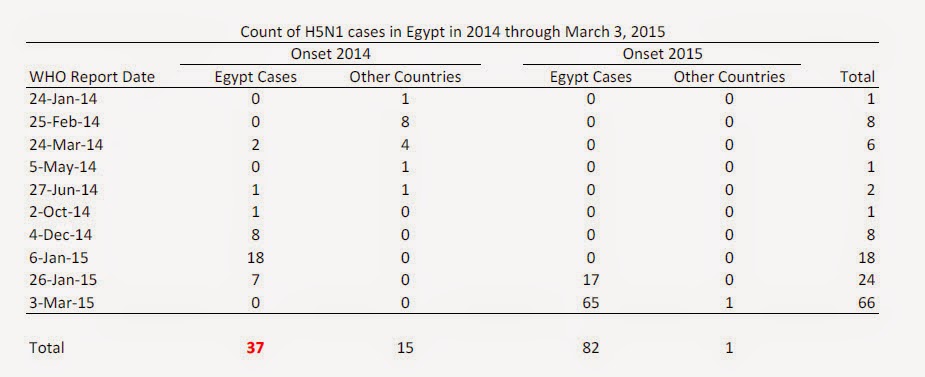
The most recent, cumulative World Health Organization (WHO) table of human H5N1 cases was published on March 3, 2015.[1] This table notes a total of 88 human H5N1 cases in Egypt through March 3, 2015. As I noted previously [2] the tabulation of counts based on the line list of cases published in the monthly risk summaries only totals 82 cases for Egypt in 2015 based on onset dates in reports of 2015.

To understand the confusion in the Egyptian case counts in the WHO table, it is necessary to consider the 2014 totals provided by WHO. The current WHO cumulative table reports 46 cases of H5N1 in 2014 with 31 cases from Egypt.[1] However, individual enumeration of WHO-confirmed H5N1 cases based on line lists in the monthly risk assessments shows a total of 52 H5N1 cases in 2014 (based on onset dates), with 37 of these reported from Egypt.[3] The table below identifies the distribution of WHO-confirmed H5N1 from Egypt by each of the monthly summaries for 2014 through the most recent assessment posted on March 3.[4]


Further complicating the confusion is the Regional Office Eastern Mediterranean (EMRO) of WHO. On March 21, 2015 EMRO published a table that only identifies 29 H5N1 cases from Egypt in 2014.[5] The EMRO data has a 8-case discrepancies with the line list of confirmed cases published by WHO.

In summary, Egypt experienced a total of 37 confirmed H5N1 in 2014 based on onset dates. In 2015, 82 WHO-confirmed cases with onsets dates before February 20 have occurred in Egypt. Since February 20, there have been at least 22 additional official cases from Egypt with onset dates on or after 20 February. Another 3 H5N1 cases have been also reported from Egypt but are not yet corroborated.

Until we get the numbers right for H5N1 in Egypt from 2014, we can’t correct the numbers for 2015. Based on the above discussion, through March 25, 2015 there have been 107 H5N1 cases in Egypt with symptom onset since January 1, 2015.  


Friday, March 13, 2015

Egypt leads the world in the number of human H5N1 cases

March 13, 2015 0 Comments


In late December 2014, Egypt surpassed Indonesia in the number of reported A(H5N1) cases.[1] As of March 3, 2015, the World Health Organization (WHO) has confirmed a worldwide cumulative total of 784 human H5N1 cases, about 37% or 292 of these cases have been reported from Egypt (Table 1). Eighty-two of those cases from Egypt occurred in the first two months of 2015.[2] In addition, media reports suggests that another four cases have occurred since late February in Egypt and may be included in future monthly updates by WHO.[3]
 

The recent WHO report from 3 March 2015 notes “ The number of laboratory-confirmed human cases of avian influenza A(H5N1) virus infection in Egypt with onsets of illness in the months of December 2014, January and February 2015 are the highest numbers reported by any country in a single month.” To put these statistics in perspective, about 36% of all H5N1 cases reported from Egypt have occurred in the last 3 months. The graph below shows the distribution of WHO confirmed cases by ISO week number in Egypt since December 2014.


 Based on onset dates, since December 2014 there have been 105 H5N1 cases reported from Egypt. According to WHO at least 28 of these individuals have died. The fatality rate among this group is 27% to date, although only 17 of these cases have been reported in media reports to have recovered.

Besides the 82 cases from Egypt since the beginning of 2015, only one other case of H5N1 has been confirmed by WHO in 2015, a 37-year-old woman from Suzhou, Jiangsu Province in the People’s Republic of China. With 83 cases so far this year, the H5N1 case count for 2015 already exceeds the annual case count of H5N1 for the preceding seven years.[4]

While the spot light is on human H5N1 infections in Egypt, the single case from Suzhou, China is a reminder that the H5N1 influenza virus is endemic in many parts of the world and that human outbreaks of H5N1 in the size and the scope now occurring in Egypt could quickly develop elsewhere in the world.


Thursday, January 9, 2014

First Human Case of A(H5N1) Imported into the Western Hemisphere

January 09, 2014 0 Comments

Influenza A(H5N1) jumped to humans for the first time in 1997 and since then more than 650 confirmed cases of H5N1 have been reported. These cases have been reported from 15 countries in Asia, Africa, Europe, but none from countries in the Western Hemisphere.

On January 8, Canadian public health officials announced that a woman, in her late 20s, from Red Deer, Alberta, died from H5N1 on Jan 3, 2014. She had returned from the People’s Republic of China via Beijing after visiting for three weeks within China. She apparently fell ill on the return flight to North America. Although it is likely she was infected in China in late December 2013, this is the first confirmed case of H5N1 reported in North America. (link below)

Should you be concerned if you live in North America?

This single case does not indicate that there is an H5N1 outbreak in North America. A single imported case in Canada should not spark pandemic hysteria. Even though over the years researchers have speculated that H5N1 could be the next pandemic virus, this case does not signal the start of a pandemic.

Of more immediate concern for people in North America is seasonal Influenza. Seasonal influenza is particularly virulent this 2013-2014 flu season. Rather than worrying about H5N1, people should educate themselves about different ways of protecting themselves from the seasonal flu varieties that are now widely circulating.

The best course of action is to monitor your local public health agencies for updates and heed any recommendations for minimizing exposure to all infectious disease.

Canada - H5N1 death in Alberta after travel from China - died from meningoencephalitis

Sunday, January 5, 2014

A Comparative Discussion of the Influenza A(H7N9) and Influenza A(H5N1) Outbreaks

January 05, 2014 0 Comments

The first human cases of infection from a reassortant avian influenza  A(H7N9) virus were reported from the People’s Republic of China (China) on March 31, 2013.[1] Since then more than 145 confirmed and probable human cases of H7N9 infection have been officially reported. Of the cases reported through December 31, 2013, about 71% are male and 29%, female. Among the reported cases, the ages range from 2 years old to 91 years old. The median age is 60.

Besides two imported case in Taiwan, one in April and one in December 2013, all other H7N9 have occurred within the country of China. A recent summary of human H7N9 cases is presented on pages 102 and 103 in Update on the situation of avian influenza A(H7N9) infection by the Hong Kong Centre for Health Protection.[2] Another current summary is available from the European Center for Disease Prevention and Control.[3] The last official World Health Organization (WHO) tabulation of cases was published in October 25, 2013.[4]


Geographic Distribution

Beside the two imported cases identified in Taiwan, the remaining 145+ cases have been reported from 13 provinces and municipalities in an area covering more than 1.3 million square kilometers in eastern China.[3] The wide geographic spread of these cases, in less than 12 months, and the fact that most of these cases are sporadic cases suggests that the infection source for H7N9 is widespread throughout eastern China.
Map: Heat map of the geographic distribution of human H7N9 cases in China between February and December 2013.
Initial investigations in early 2013 suggested that some of the H7N9 infections were caused by exposure to poultry. In a tabulation of samples testing positive for H7N9, chickens and environmental samples (most from live bird markets) frequently tested positive.[5] These data indicate that chickens are the most likely host reservoir for the virus although a few ducks and pigeons have also tested positive for H7N9. H7N9 infection in poultry sources is unlike Influenza A(H5N1) infection  which often causes extreme morbidity and mortality in poultry populations. H7N9 does not seem to be fatal for poultry stock, as evidenced by the dispersed geographic distribution of positive H7N9 animal and environmental samples.


H7N9 Clusters

A human cluster of cases is generally defined by WHO as two or more cases of confirmed, probable, or suspected infections with onset of illness occurring within the same two-week period and who are in the same geographical area and/or are epidemiologically linked.

At least six human H7N9 clusters, including both confirmed and probable cases, have been identified among the reported H7N9 cases from China. Three family clusters occurred between February and April 2013. These clusters include a father and two sons in Shanghai Province in February and March, 2013, a husband and wife from Shanghai Province in March and April, 2013, and a father and daughter from Jiangsu Province in April 2013. In addition, one neighborhood cluster including one adult and two children occurred in Houshayu in Shunyi District, Beijing Municipality in April, 2013.[6][7]

Another confirmed family cluster in Zaozhuang, Shangdong was reported in April 2013. This cluster includes a 36-year-old man and his 4-year-old son.[8] Most recently, a family cluster consisting of 57 year-old man and his 30-year-old son-in-law was reported from Zhejiang Province in December 2013.[9]


Comparison of Human H7N9 and H5N1 infections

At least two published papers provide epidemiological comparisons between H5N1 and H7N9 cases. Influenza A(H5N1) is another emerging infectious disease. It was first identified in 1997 and since that infected more 650 individuals from 15 countries around the world.

A paper published in June 2003 in Lancet entitled Comparative epidemiology of human infections with avian influenza A H7N9 and H5N1 viruses in China: a population-based study of laboratory-confirmed cases compares 43 reported H5N1 cases from China with 130 H7N9 cases through May 24, 2013. Another article, entitled Age-specific and sex-specific morbidity and mortality from avian influenza A(H7N9), reports on 136 H7N9 cases by age and sex with comparisons to H5N1 cases. Both of these articles are published in journals behind a pay wall. The details and results the analysis are not publicly available, although there are significant differences between the outbreaks of H7N9 and H5N1.

In less than 12 months since the initial H7N9 cases were reported, more than 145 peoples have been infected. The official WHO count of human H5N1 infections did not reach 145 cases until 24 months after WHO starting reporting cases in December of 2003. It was the resurgence of the H5N1 virus in a family cluster from Fujian, China in January 2003 [10] that reignited the concern for this emerging disease, although WHO did not officially start tracking H5N1 cases until January of 2004. For comparison, the initial 11 month period from January to December in 2004 (corresponding with the 11 months that have passed since the reporting of the initial H7N9 cases) only 48 human H5N1 cases were reported.

Age and Gender Differences

People of different ages are differentially infected by these two novel influenza viruses. The median age of infection for H5N1 cases is 18 years old. For H7N9, the median age is 60 years old. About 79% of H5N1 cases are less than 30 years in age. Of all of the H7N9 cases, 70% are older than 50 years.

Graph: Comparison of differential infection by Age Group of H7N9 and H5N1. 

These two influenza viruses seem to attack by gender differentially as well. Females are more likely to be infected with H5N1 than males. In contrast, males are more than twice as likely to be infected by H7N9 as females.

Graph: Comparison of differential gender infection of H7N9 and H5N1.


Mortality Comparison 
Through December 31, 2013 the case-fatality ratio for H7N9 is .31; for all WHO-confirmed H5N1 cases the CFR is .53. The differential infection rate by age groups between H7N9 and H5N1 cases limits any meaningful comparison for mortality rates among these two novel infectious influenza viruses.


Discussion

The lack of human H7N9 clusters indicates that the sporadic human infections are not a result of widespread human-to-human transmission. Additionally, the lack of H7N9 infections among health care workers indicates that human-to-human transmission is rare. The far-reaching geographic distribution of sporadic human H7N9 cases in China suggest the infection source is widely spread, and possibly ubiquitous, in Eastern China. The limited temporal data available suggests that H7N9 infections will follow cyclical seasonal pattern of seasonal influenza similar to the season pattern of H5N1 infections.

Graph: Percent of all H7N9 and H5N1 cases by month of infection.
As with H5N1, poultry exposure is the primary source of H7N9 infection. In contrast to HPAI H5N1 infections in poultry populations, H7N9 does not cause large-scale morbidity and mortality in domestic poultry populations. This makes surveillance for both human cases and animal outbreaks more challenging.

In 2003, influenza H5N1 reemerged as a potential pandemic threat. In 2013, another reassortant virus, H7N9, began infecting humans and this virus may also have the potential to spawn a pandemic. Finally, just few weeks ago another novel influenza virus A(H10N8) infected a woman in China. This is first known case of a human H10N8 infection. With three novel influenza virus with possible epidemic or pandemic potential, public health officials and government agencies need to expand surveillance and promote additional influenza research and vaccine development.


Acknowledgements and Notes

I thank all of the internet sources, posters at FluTrackers.com, and other internet disease trackers for their online efforts to follow and track H7N9 and other emerging infectious diseases. Thanks are also due to open source journals and researchers who post full copies of their papers and data sets.

The data and information used here have been derived from numerous publicly available sources including WHO, various ministries of health, internet bloggers, Internet forums, and other media reports available online through December 31, 2013. For some individual cases, specific details are lacking or conflicting information is presented in online reports. There are also discrepancies in case statistics reported by various public health organizations and government agencies. However, the information and graphics presented here are based on data which is believed to be reasonably accurate and current through December 31, 2013.


[1] www.who.int/csr/don/2013_04_01/en/index.html

[2] www.chp.gov.hk/files/pdf/cdw_compendium_2013.pdf 

[3] http://www.ecdc.europa.eu/en/publications/Publications/Communicable-disease-threats-report-4-jan-2014.pdf

[4] http://www.who.int/entity/influenza/human_animal_interface/influenza_h7n9/10u_ReportWebH7N9Number.pdf
 
[5] http://www.flutrackers.com/forum/showthread.php?t=213227

[6] http://www.flutrackers.com/forum/showpost.php?p=494384&postcount=1

[7] http://www.nejm.org/doi/suppl/10.1056/NEJMoa1304617/suppl_file/nejmoa1304617_appendix.pdf

[8] http://www.flutrackers.com/forum/showthread.php?p=497695

[9] http://www.who.int/csr/don/2013_12_10/en/index.html
 
[10] http://www.dh.gov.hk/textonly/english/useful/useful_ld/useful_ld_h5n12003.html

Follow Us @soratemplates